By Beverly Andrews
How does an artist make sense of a world that, at times, renders them invisible? It’s a question that has long confronted Black artists across the African diaspora. In the wake of George Floyd’s death, that question has taken on a new urgency—one that is both personal and political.
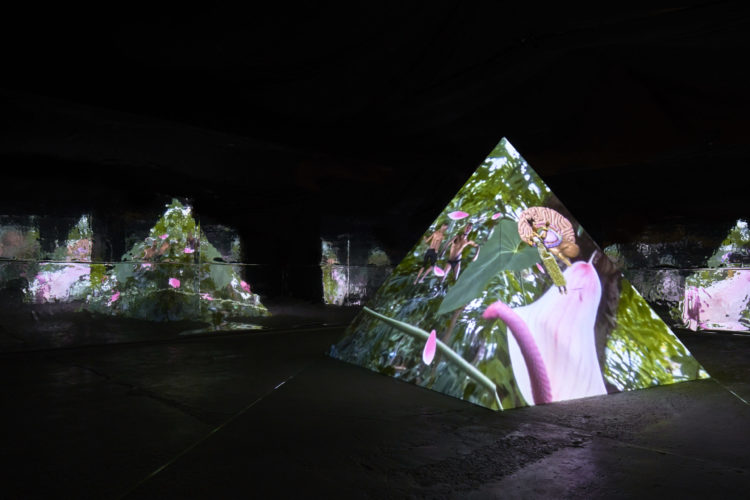
The Hayward Gallery’s new exhibition, In the Black Fantastic, offers a dazzling, thought-provoking glimpse into how Black artists around the world are responding to that challenge. From surrealists to Afrofuturists to those who defy easy categorisation, this show is a feast for the senses—and unquestionably one of the must-see cultural events of the summer.
Curated by journalist and author Ekow Eshun, the exhibition is groundbreaking. As Eshun explains in the exhibition catalogue, In the Black Fantastic is the first major art show of its kind to bring together Black artists who use myth, fantasy, and science fiction to confront racial injustice while exploring imagined alternative realities.
But Eshun is quick to point out that this is not a rigid artistic movement or narrowly defined genre. Rather, it is a shared way of seeing the world—one where artists grapple with the realities of racial inequality by conjuring new narratives of Black possibility.
The works on display are not only visually arresting but also resonate with broader cultural currents. From the southern gothic imagery of Beyoncé’s Lemonade to the global success of Marvel’s Black Panther, and the speculative brilliance of Octavia Butler’s science fiction, this exhibition reflects an artistic conversation that is already well underway.
In the Black Fantastic doesn’t claim to lead that conversation—it simply, and powerfully, illuminates it.
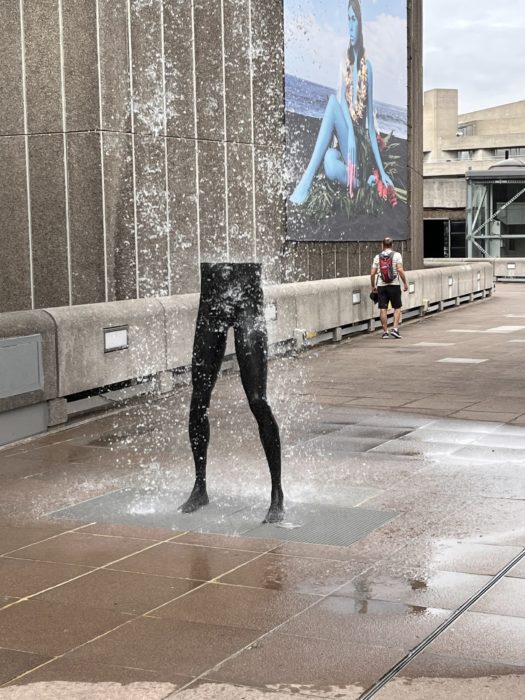
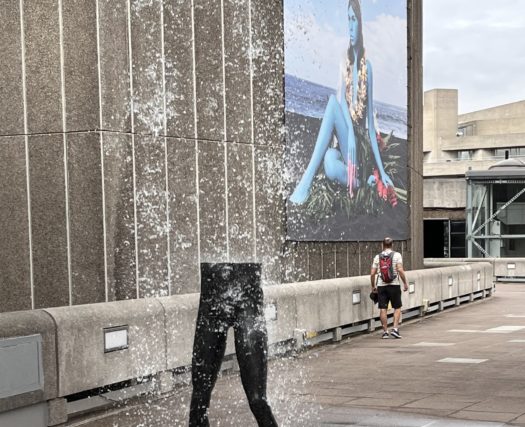
Before you even set foot inside the Hayward Gallery, you’re met by a striking, uncredited outdoor installation: the sculpted legs of a Black woman positioned beneath a cascading waterfall. This anonymous work immediately signals that you are stepping into a different reality—one where conventional boundaries dissolve and new narratives take shape.
Inside, the first gallery space introduces the work of acclaimed African American artist Nick Cave and his new commission, Chain Reaction. The installation features a series of interlocked hands, cast from Cave’s own, suspended delicately from the ceiling. From a distance, the entwined hands appear to symbolise unity and cultural solidarity. But a closer look reveals a more fragile reality—their grasp is tenuous, precarious, as though the slightest disturbance could cause them to separate. It serves as a haunting metaphor for life within the African diaspora: no matter the steps taken to build security, stability can be undone in an instant. In America, for example, that precariousness might hinge on something as arbitrary—and potentially dangerous—as an unforeseen traffic stop.
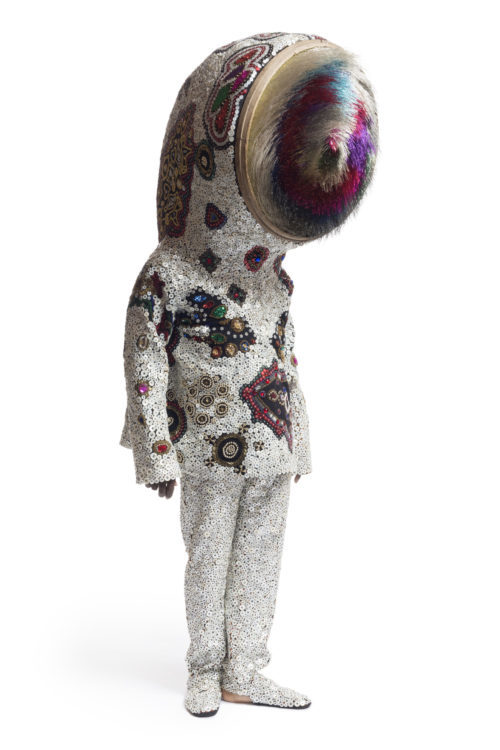
Elsewhere in the same gallery, Cave’s renowned Soundsuits command attention. Created in the aftermath of the brutal, videotaped beating of Rodney King by LAPD officers—an event that sparked widespread outrage and the Los Angeles riots—the Soundsuits are both futuristic and otherworldly. Their elaborate designs conceal the wearer’s identity entirely, erasing markers of race, gender, and class. At once visually arresting and deeply symbolic, they function as protective armour—an artistic response to a world that can often be hostile toward those society deems “the other.”
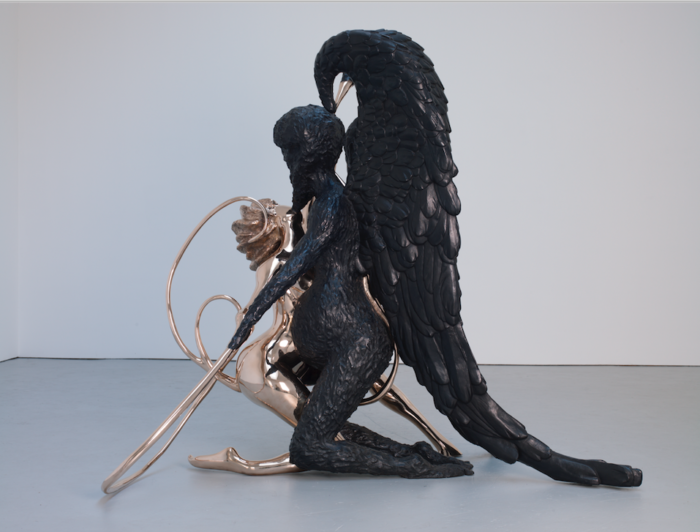
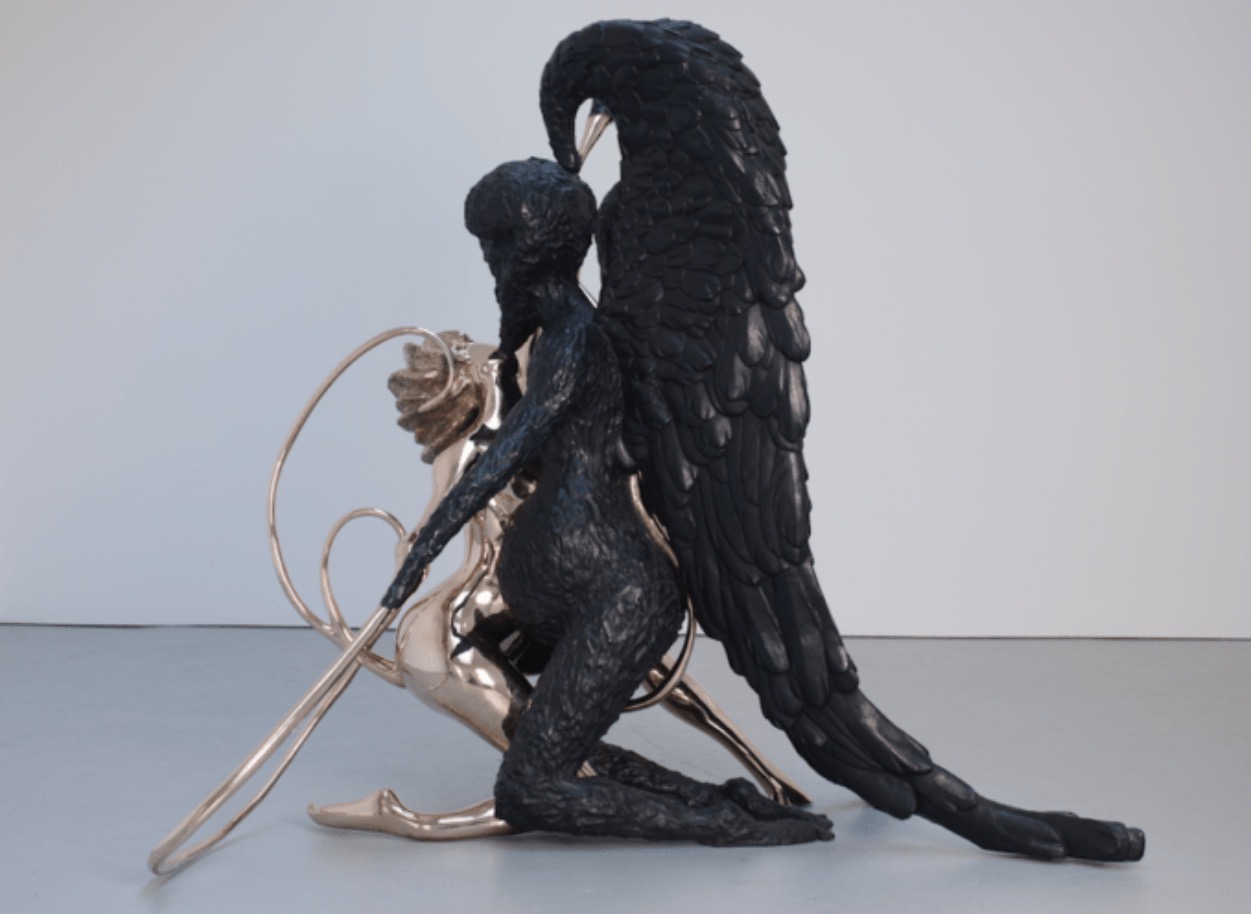
Among the standout voices in the exhibition is Wangechi Mutu, one of several female artists featured. Known for her arresting collages, Mutu describes her work as “a way of destroying a certain set of hierarchies that I don’t believe in.” Drawing inspiration from her travels, she incorporates natural materials—soil, stones, shells—into sculptures that evoke the divine, feminine form and mythical guardians. “They look like they are guarding me, guarding language, and the earth that they’re made from,” she explains.
Perhaps the most striking of her contributions is a surreal short film depicting a monstrous, feminine sea creature who devours everything in her path, only to release toxic gases that ultimately destroy her own world. It’s a haunting and unmistakable metaphor for humanity’s relentless, unchecked consumption—an environmental and existential warning we would be wise not to ignore.
Wander further through the gallery and you’ll encounter the work of Lina Iris Viktor, whose paintings shimmer with beauty and historical weight, weaving together myth and legend. Her series A Haven. A Hell. A Dream Deferred reflects on the history of Liberia, the West African nation founded in 1822 as a resettlement project for free-born and emancipated African Americans. At the time, political leaders—including President Abraham Lincoln—deemed a truly multicultural America an impossibility. In Viktor’s work, she presents herself as the Libyan Sibyl, a prophetic figure from Greek mythology who, legend has it, foresaw the transatlantic slave trade. The Sibyl’s image was even invoked by abolitionist groups during their fight to end slavery, making Viktor’s self-portrait both personal and politically charged.
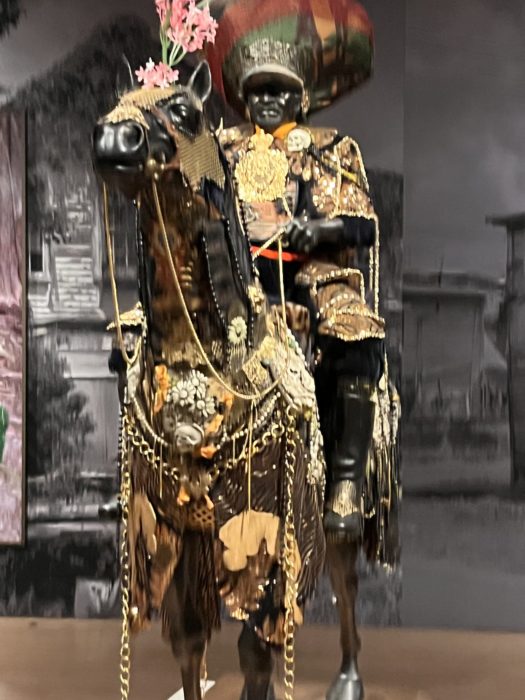
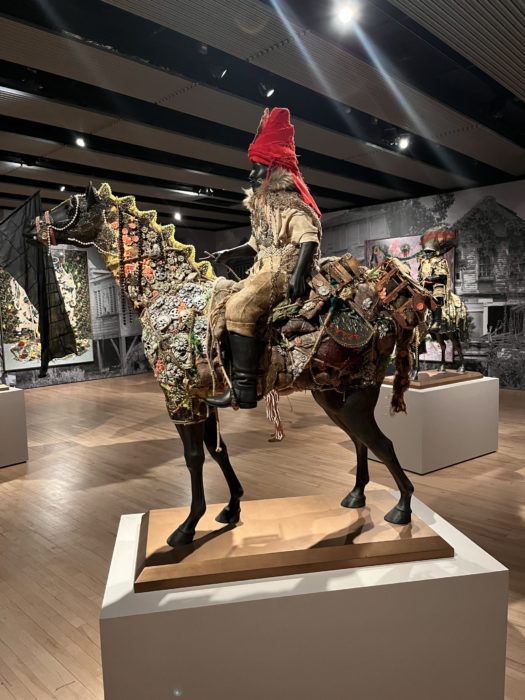
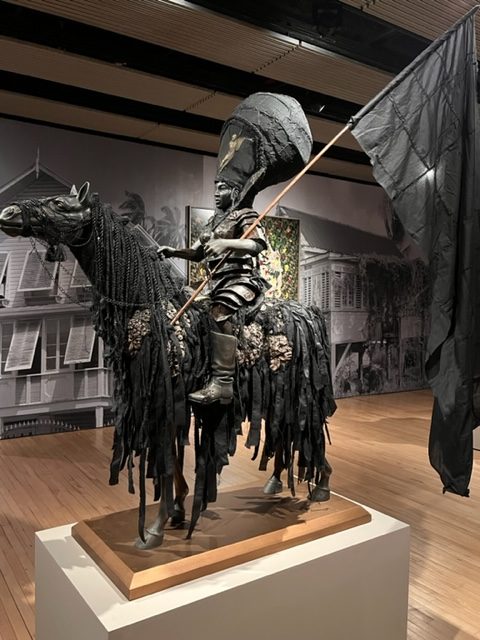
In another gallery, Hew Locke’s Ambassadors commands attention—a quartet of bejewelled kings on horseback, statuesque and regal. These figures may evoke Black revolutionary leaders such as Toussaint Louverture, who spearheaded Haiti’s successful revolution. Their majesty is set against haunting, floor-length photographs of decaying Guyanese homes—an homage to the artist’s heritage and to his father, the acclaimed Guyanese artist Donald Locke. Whether this juxtaposition serves as a commentary on the fragility of power or as a reminder of the historical roots from which revolutionary movements emerge is left deliberately ambiguous. What is certain, however, is the lush visual richness of Locke’s work.
The boundary between gallery space and performance art is further blurred in the work of Rashaad Newsome. Entering his gallery room, you could be forgiven for thinking you’ve stumbled into a nightclub. The space pulses with electronic dance music—the infectious soundtrack to Newsome’s futuristic short film Build or Destroy. On screen, a Blade Runner-esque cityscape burns as a beautiful young Black trans woman, who eventually transforms into an AI entity, Vogues defiantly to the beat.
But this isn’t simply a dystopian fantasy—it’s a statement. Newsome describes the destruction depicted not as the collapse of a physical space, but as the dismantling of a restrictive state of mind. The rigid, outdated systems that have governed society, he suggests, must be torn down to make way for a more inclusive, progressive way of thinking.
Elsewhere in the exhibition, Turner Prize-winning artist Chris Ofili presents his signature reimagining of European foundation myths—from Homer’s Odyssey to the Biblical Annunciation. Ofili doesn’t merely retell these stories—he infuses them with sensuality, colour, and life, casting their narratives through a fresh, contemporary lens. This practice has long been central to Ofili’s work: taking the familiar, often Eurocentric, tales of Western culture and recasting them with new meaning—layered, provocative, and utterly captivating.
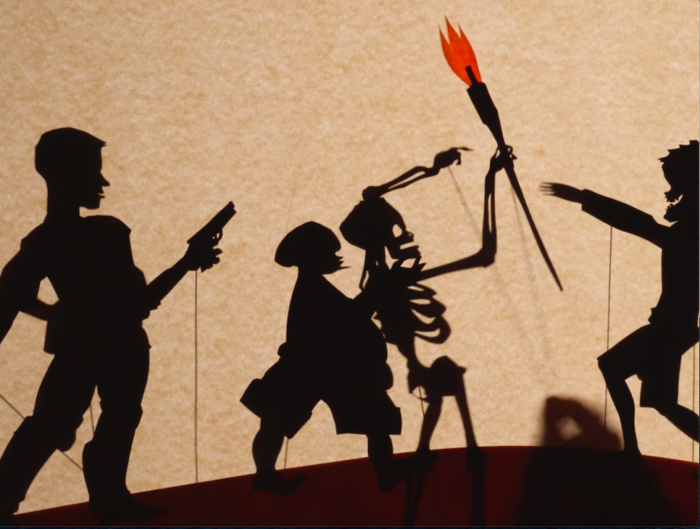
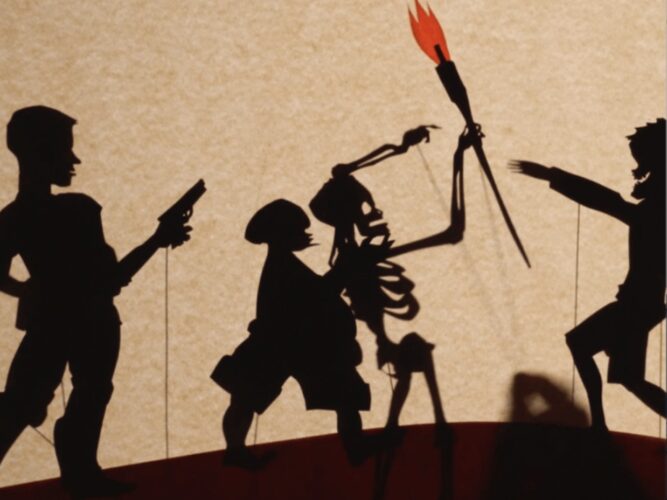
African American artist Kara Walker is renowned—and often controversial—for her use of cut-paper silhouettes to depict unsettling scenes of sex and violence rooted in American history. Walker never shies away from confronting the brutality that has shaped—and continues to shape—the lives of African Americans.
Her video installation featured in the exhibition, Prince McVeigh and the Turner Blasphemies, is a striking example. The title alludes to two grim chapters in American history: Timothy McVeigh, the white supremacist responsible for the Oklahoma City bombing that killed 168 people, including 19 children; and the horrific murder of James Byrd Jr., a Black man lynched by being dragged behind a truck in Texas.
The animation, with its child-like visual style, is at once disarming and deeply unsettling. But in Walker’s hands, this juxtaposition is deliberate. The almost naive aesthetic underscores the tragic normalisation of violence against minority communities—violence so pervasive, so historically entrenched, that it begins to feel disturbingly routine, even like child’s play. It’s a sobering reminder of the enduring impact of America’s darkest legacies.
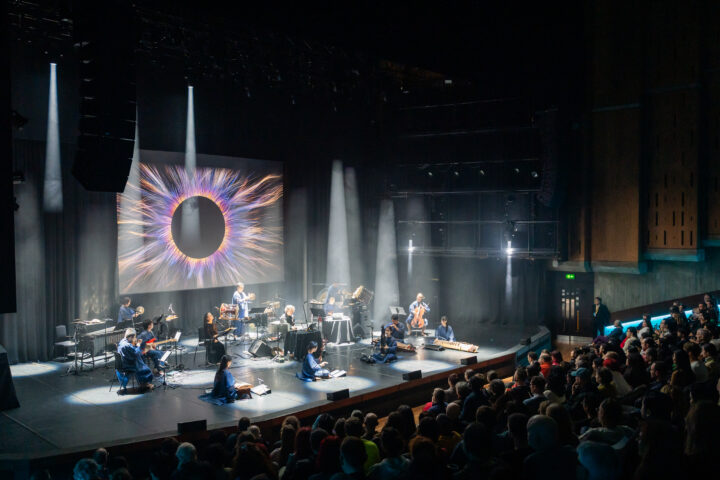
Complementing this blockbuster exhibition is a series of evening performances that run throughout its duration. The event I attended brought together editor Ellah P. Wakatama with Space Afrika, the futuristic dub techno group, and artist Alistair MacKinnon to create an immersive, otherworldly soundscape that accompanied a selection of literary readings curated by Wakatama. The chosen works explored the Black experience through the lens of myth, fantasy, and speculative fiction.
As with any ambitious collaboration, not every element landed perfectly—but the moments that did were nothing short of breathtaking. Among the standout readings was a passage from Chinua Achebe’s African classic Things Fall Apart. The excerpt reflected poignantly on the alienation and sense of displacement that often accompanies immigration to Europe—a lingering feeling of otherness that, for many, never fully fades.
It was a fitting addition to an exhibition that consistently challenges audiences to reimagine identity, history, and belonging through the boundless possibilities of the fantastic.
The evening also featured an outdoor DJ whose infectious mixes had the multiracial crowd dancing well into the night. It was a vibrant, joyful atmosphere—briefly overshadowed by an unfortunate incident at the entrance to the Queen Elizabeth Hall. Despite the fact that the venue was hosting a Black cultural event that evening, a pair of overzealous security guards stationed at the entrance appeared visibly uneasy about the number of Black theatre-goers arriving. They were checking tickets at the building’s entrance, despite the foyer being a public space with a café that is normally open and accessible to all.
The diverse crowds that gathered that day—drawn to both the exhibition and the evening’s performances—offered, for me, a powerful reminder of how far British society has come in terms of cultural openness and inclusion. But the unnecessary policing at the door served as a sobering reminder of how far we still have to go.
In the Black Fantastic runs until 18th September at London’s Hayward Gallery and is accompanied by a programme of evening events. For details, visit the Southbank Centre website.
In the Black Fantastic (southbankcentre.co.uk)