By Beverly Andrews
Short films are often the best calling cards for aspiring film directors. Cheaper to produce and offering far greater artistic freedom, they frequently serve as strong indicators of a filmmaker’s potential. The LA-based HollyShorts is one of the most celebrated short film festivals in the world, screening more than four hundred films each year. From indigenous debuts to Afro-futurist narratives, HollyShorts is a cinephile’s delight. Below are just a few of my favorites from this year’s festival.
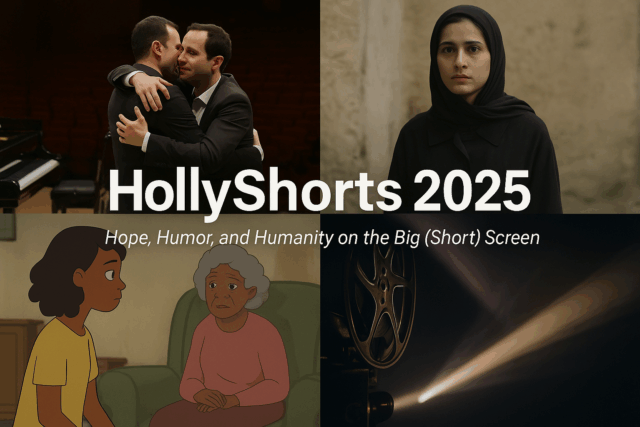
Screened in the documentary section, Amal could not be more timely. It charts the unlikely, lifelong friendship and professional collaboration between Palestinian pianist Bishara Haroni and Israeli pianist Yaron Kohlberg. We see them deliver acclaimed joint performances, their music so perfectly synchronized it seems as though they play as one. Interwoven are heartfelt interviews with family members reflecting on the improbability of such a partnership in such a fraught region, alongside moving conversations between the two men about how their friendship has shaped and challenged them. After one especially well-received performance, when the two take their curtain call and Yaron gently places his arm across Bishara’s shoulder, the simple gesture resonates with a quiet but powerful hope—hope that feels rare in the current climate of the region. It is all the more poignant to learn that “Amal” means “hope” in Arabic. During these dark times, Amal reminds us that art truly can transcend even the most intractable divisions.
Another standout short was the award-winning Iranian film Black Scarf, directed by Alireza Shahhosseini. The story follows the final day of teaching for a schoolteacher in a rural Iranian town. The film captures the tension between his young female students—desperate for him to stay—and the men in the village, who threaten violence in an effort to suppress the ideas and aspirations that education has sparked in the girls.
Watching Black Scarf, it is tempting to assume that such resistance to women’s education is confined to communities in the Global South. Yet, a closer look at the current atmosphere in the West suggests that hostility toward women’s advancement is, in fact, a growing global problem.
Snipped is a hilarious short about a Jewish convert in Denmark who, as an adult, must undergo ritual circumcision. The only problem is that the local Jewish doctor has retired, leaving the procedure in the hands of a kindly Muslim physician—whose nurse happens to be Palestinian. Director Alexander Saul skillfully takes us into the protagonist’s anxious inner world, where his mind races with every possible mishap that could occur. With so much tragedy tied to this fraught relationship, it is refreshing to see the subject handled in such a light yet thoughtful way.
L’Avance marks Djiby Kebe’s directorial debut, and it opens with a young, promising Black art student at the Beaux-Arts making the painful decision to sell a cherished painting of his late mother to a well-known collector. The film follows Aliou, a student of African descent living in France, as he grapples with the cost of that decision. While the sale represents an opportunity for career success, it also raises the question: at what price? Once the money arrives, does his standing within his family shift in damaging ways? Kebe’s first film is a knockout, featuring an extraordinary performance by Saabo Balde, who brings Aliou’s inner conflict vividly to life. His expressive face captures all the complexities that artistic success can impose.
Shadows in the Sunlight tells the extraordinary story of one woman’s fight to vaccinate children against polio in some of Pakistan’s poorest communities. Battling both deep-rooted distrust of Western medicine and the traditional limitations placed on women in rural society, Ishrat Rahim and her team emerge as heroic figures, working tirelessly to protect children from the ravages of the disease. Often forced to travel with armed security, Rahim remains relentless—willing to risk her own life to save others.
And finally, my personal favorite: the remarkable Aicha, directed by Sanaa El Alaoui. The film weaves together past, present, and future with striking skill, while exploring the fraught relationship between a mother and daughter—a bond where love is present but rarely spoken, perhaps only to be realized too late. Blending live action with animation and shot on Super 8, Aicha also reflects on the broader reality of places where violence against women is met with little consequence, and where change remains elusive.
HollyShorts offers a glimpse into the work that future star directors may one day create—and if this year’s lineup is any indication, we have a great deal to look forward to.
Beverly Andrews, London.