By Bettina Gracias
I am not an opera aficionado but, from the moment the magnificent curtain opened on The Fenice’s production of Simon Boccanegra, I was hooked. From the first note emanating from the wonderful Luca Salsi’s lips, I understood the human connection to a yearning for heightened emotion in this troubled world. Here we could both lose ourselves and relate. As adults, we live restrained lives, as Freud wrote, we make an unspoken pact with society to control our natural instincts in return for comfort and safety. The price we pay is suppression, not just of those urges that could cause harm to others but also a pushing down of childlike joy and spontaneity in order to conform. Contemporary theatre is often a reflection of this sedate behaviour. But this opera felt like a place to let go, to feel joy and pain deeply and express it freely. As a spectator I felt that this was a space to release these suppressed instincts and emotions surreptitiously. I felt a connection to the audience who were completely engaged in the production unfolding before them, reminiscent of how it must have been to be part of a Shakespearian production in the early days of The Globe.
When Verdi’s opera, Simon Boccanegra, first appeared at The Fenice in Venice in March 1857, it was badly received. Verdi was upset by this and felt that it had been misunderstood. He resisted advice to rewrite it until 1880, when he finally revised it, the latter version reflected both his maturity and the changing Operatic scene of the day. The second version of the opera debuted with resounding success at La Scala in Milan in March 1881, but it was not until a 1930s production in Germany that it began to be truly appreciated by a wider society.
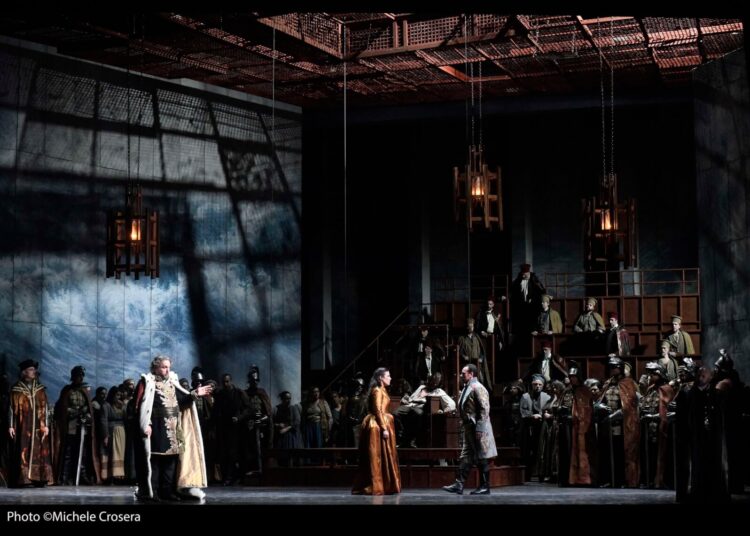
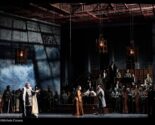
Knowing that this opera had opened at The Fenice over one hundred and fifty years ago added to the excitement and weight of the current production. Directed by Luca Micheletti who saw the piece as very Ibsenian in the sense that a powerful man can be overwhelmed by regrets, fear and guilt. Simon Boccanegra is, in a sense, a victim as he only becomes doge to secure his relationship with his love but, at the moment he is pronounced victorious, he discovers she has died. He is then a prisoner of his own position and fate. The opera reflects Verdi’s theme that power is an individual tragedy and politics is the mask of the heart. Micheletti acknowledged that the themes of this opera may have relevance today but he did not think it necessary to set it in contemporary times to make that point. He rightly, in my mind, left that association to the audience.
The set, designed by Leila Fteita was striking yet simple and worked well with two backdrops of the sea, a place that Simon Boccanegra had sacrificed to become doge. All the singers, Luca Salsi as Simon, Alex Esposito as Fiesco, Simone Alerghini as Paolo, Alberto Comes as Pietro and Francesca Dotto as Maria, were excellent.
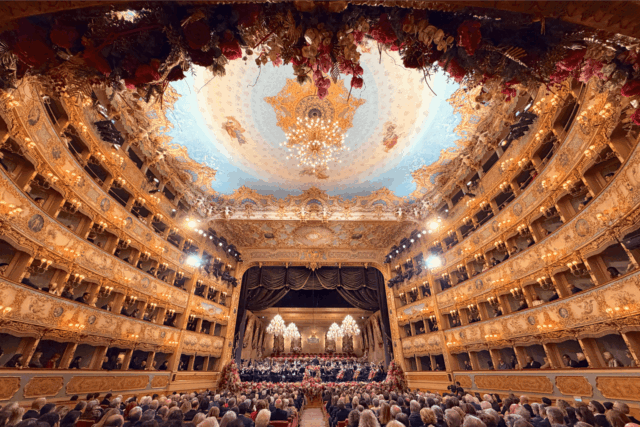
The Fenice itself is an outstandingly beautiful building and it is a gift to the eyes to look around the chocolate box interior whilst waiting for the magnificent curtain to open. I am eagerly looking forward to the next opportunity to see a production there.
Simon Boccanagra is on at La Fenice until the 14th of February 2026.