Bird Grove
By Bettina Gracias
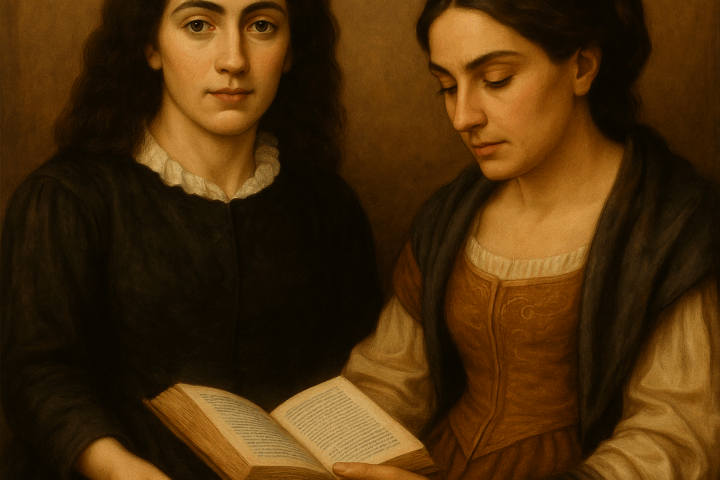
It is interesting that Alexi Kaye Campbell (Bird Grove) and Helen Edmonson (Mary Shelley) chose to focus on the relationship between father and daughter when writing plays about George Elliot and Mary Shelley. Both women were closely attached to their fathers and both were rejected by them when they chose to assert their independence. It is perhaps because the father daughter relationship in the 1800s reflects the constraints of women in the patriarchal society of the time perfectly. Despite raising their daughters in a more ‘liberal’ way by encouraging their education at a time when it was considered unusual, when George Elliot declared that she no longer wanted to accompany her father to church, and Mary Shelley had an affair with Percy Shelley, the two ‘freethinking’ fathers became utterly conservative.
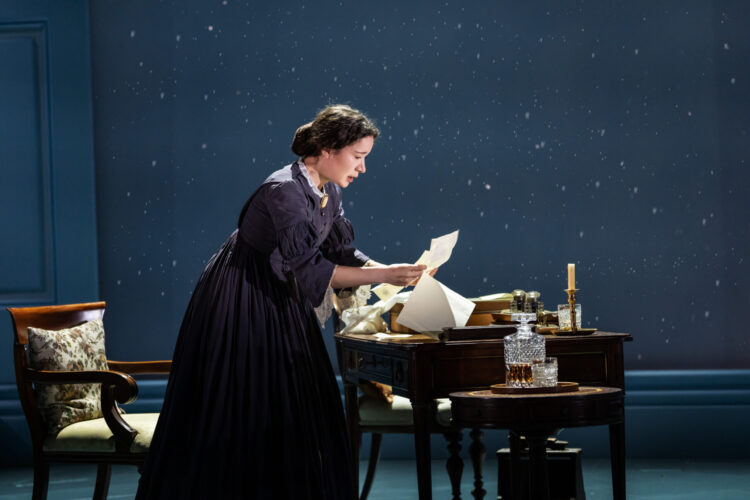
There is much in George Elliot’s life that could be dramatized. After her father died, she left their family home, Bird Grove, and went to live in London. There she met a stimulating group of people with whom she attended literary events, parties at which writers discussed politics and philosophy, concerts and operas, feeling free for the first time to live as herself. But, when she fell in love with a married man, she was ostracized by this society and the invitations stopped coming. She later fell in love with George Lewes, with whom she lived as man and wife without marriage, which resulted in only their male friends from the Westminster Circle visiting them, without their wives, and Lewes being invited out to dinner without her. Then there was the ‘shock’ when it was revealed that George Elliot, one of England’s finest novelists, was not a man but a woman, not just a woman but one who was a non-believer and living in sin, whose real name was Mary Ann.
Two years after Lewes died in 1878 she accepted the marriage proposal of a banker, John Walter Cross, a man twenty years younger than herself which caused another ‘shock’ to society. Cross suffered from depression and threw himself into a Venice Canal during their honeymoon, he survived, however, and Mary Ann Cross (George Elliot) died a few months later from kidney disease exacerbated by a throat infection. They did not grant permission for her to be buried in Westminster Abbey because of her ‘irregular’ life with Lewes and her denial of the Christian faith, so she was buried at Highgate cemetery on the 29th of December in 1880 alongside her former love.
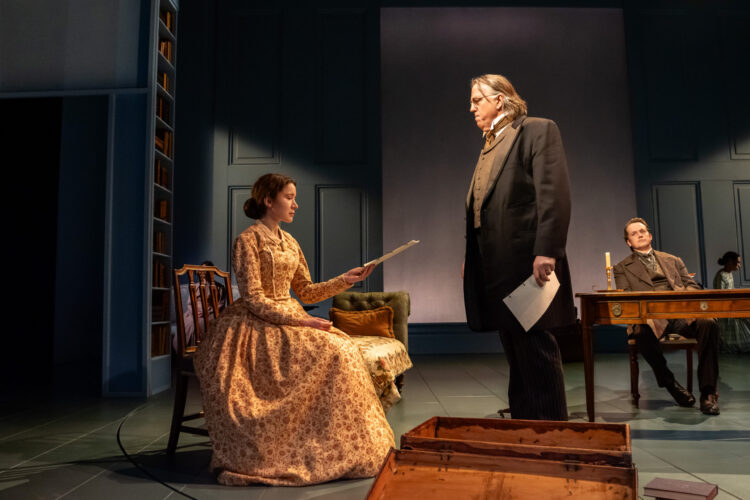
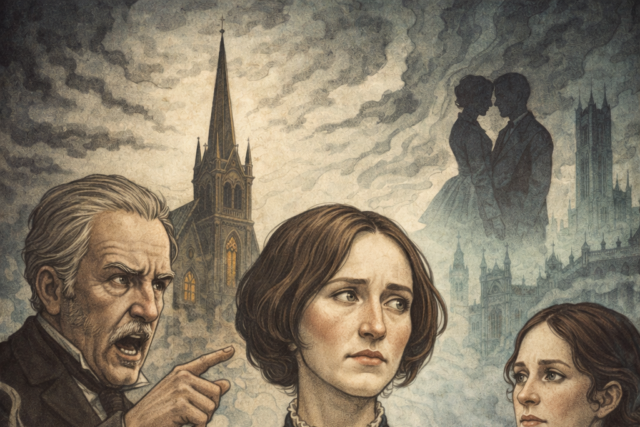
In her writings, George Elliot persistently interrogated female stereotypes and the social fate of women. The term ‘The Woman Question’ emerged in the nineteenth century as traditional values were being questioned, particularly after the French Revolution in 1789 which triggered the 1832 Reform Act in England. In Alexi Kaye Campbell’s play, Bird Grove, he focuses on the irony of the fact that George Elliot’s father encouraged her, from a very young age, to go to the library and read, which was considered unusual for girls at the time, he appreciated her intelligence and questioning mind, but when this led to her questioning the Christian Church and her belief system, this was a step too far. In the play the father argues that they moved to Bird Grove, in Coventry, a house far above their station, in order to find a husband for her, as that was the only hope for women in those times to ensure a secure life. Not attending church on Sundays, would be too blasphemous for the community to accept and would rule out any hope of finding a suitor. Although this has largely changed, there are still communities today in which attending church is a social pressure, and societies in which wealthy parents send their daughters to boarding schools in the West to gain a good education but expect them to return home and accept an arranged marriage organized by the family.
Mary Shelley, who wrote Frankenstein, also suffered such a conflict in her family. Her mother was Mary Wollstonecraft who wrote,’ A Vindication of the Rights of Woman’ in 1792, in which she argues that women are not naturally inferior to men but may appear so because they have less access to education. She moved in a radical circle and married the political philosopher and novelist William Godwin. Wollstonecraft died 11 days after giving birth to her daughter Mary, who was then raised by her ‘radical’ father, who gave her a rich, informal education and encouraged her to adopt his own anarchist theories. But, when she fell in love with Percy Bysshe Shelley, a friend of her father’s, who was married, her father disowned her. Mary and Percy left England to live in France and travel Europe, when they returned to England they were ostracized.
Both women led interesting lives and many plays could be written focusing on different aspects of them. Perhaps Alexi Kaye Campbell and Helen Edmonson both chose to focus on the relationships between these women and their fathers because they reveal how the personal is political and no matter how liberal and freethinking one may be societal norms can constrain and influence us.
Bird Grove is on at Hampstead Theatre until the 21st of March.