Patronesses and Salon Hostesses
By Claudio Sales Palmero
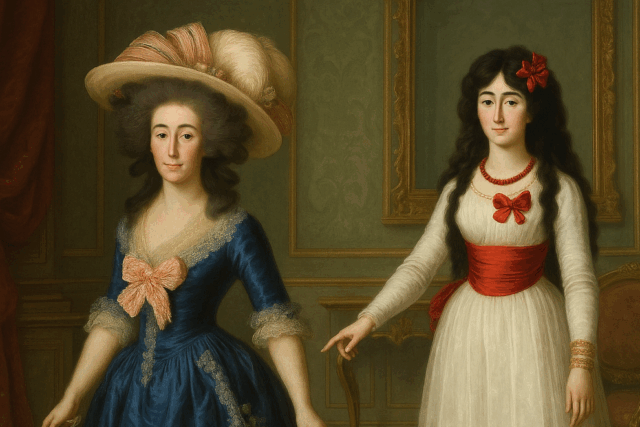
The Duchesses of Osuna and Alba, immortalized by Goya, are two of the foremost figures of the Enlightenment in Spain. As salon hostesses and patrons of the arts, they made the most of the freedom afforded to them by their status and wealth as heiresses of their respective noble houses.
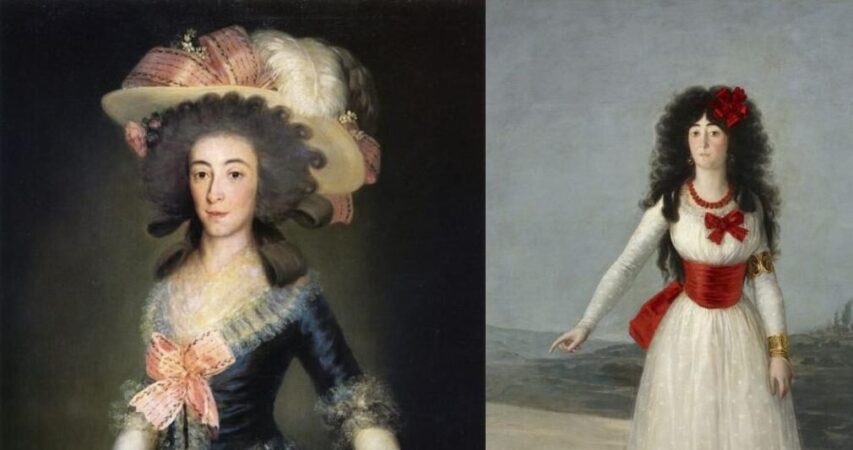
María Josefa Pimentel y Téllez-Girón (Madrid 1752 – Madrid 1834), Countess-Duchess of Benavente and Duchess Consort of Osuna
María Josefa Pimentel, better known by her title as Duchess Consort of Osuna, belonged to the highest ranks of the Spanish nobility. From this exceptionally privileged position, she stood out in Madrid society as one of the leading promoters of the Enlightenment in Spain. Her salons served as gathering places for writers, politicians, scientists, and artists, where they mingled with the nobility and found a platform for gaining influence at court. According to contemporary descriptions, she was not considered very beautiful, but was known for her sharp intellect, refined elegance, and poise.
She was the first woman to belong to the Sociedad Económica de Amigos del País(Economic Society of Friends of the Country), institutions founded during the reign of Charles III to discuss, promote, and implement the reformist ideas and technological advancements that were transforming 18th-century Europe. Unfortunately, her full membership as a woman caused discomfort among some members, leading to the creation of a parallel association of ladies, of which she became president.
Her extensive contacts abroad allowed her to stay up to date on what was happening across the rest of Europe, not only in literature and the arts, but also in the field of science.
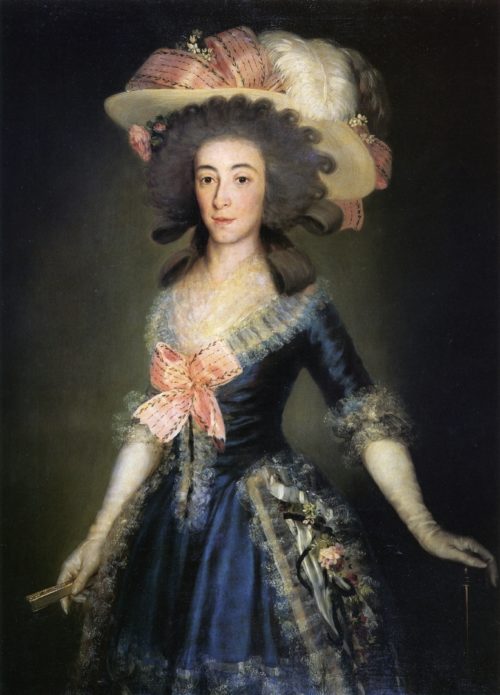
She and her husband were the first patrons of Goya. They commissioned portraits, sets of engravings, and the decoration of their new palace on the outskirts of Madrid, which the duchess affectionately called “mi capricho” (“my whim”). Among these works is the famous painting The Witches’ Sabbath (El Aquelarre). Their patronage was instrumental in Goya’s rise at court, eventually leading him to become the official court painter.
For the creation of the palace Mi Capricho, now known as El Capricho de Osuna, the duchess purchased land in 1783 and devoted herself to its beautification as a personal project until her death in 1834. She brought in French landscapers and architects on the condition that they work exclusively for her and return to France upon completing their assignments. In 1787, Jean-Baptiste Mulot—who had worked on the Petit Trianon—was responsible for the initial design, later succeeded by Pierre Provost. The gardens, with their ponds, reflect the Enlightenment-era ideal of the countryside as an idyllic retreat.
The palace also housed an extensive library, which included banned books, as the duke was exempt from censorship laws. El Capricho de Osuna, beautifully preserved, is today one of the most enchanting places in Madrid.
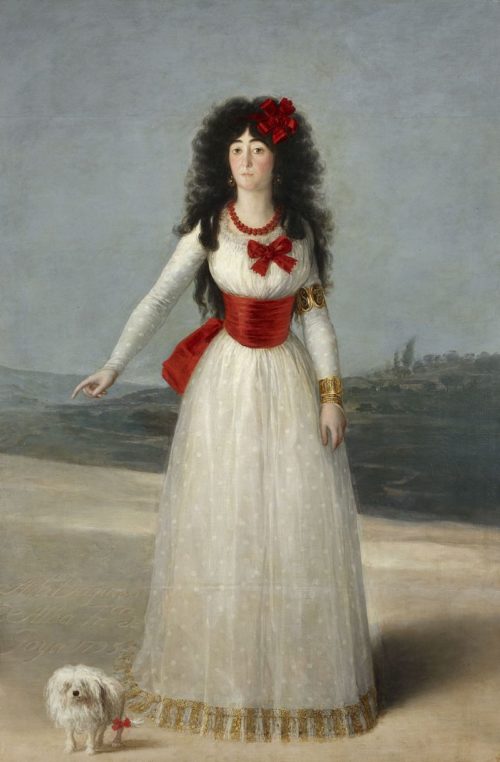
María Teresa de Silva Álvarez de Toledo (Seville 1762 – Madrid 1802), Duchess of Alba de Tormes and Duchess Consort of Medina Sidonia
As the Duchess of Alba in her own right, with 31 noble titles and their associated lordships, Cayetana—as she was commonly known—was an immensely wealthy and powerful woman. This wealth granted her an uncommon degree of freedom, even among high-ranking noblewomen—a freedom that, during her lifetime, gave rise to all kinds of rumours that continue to spark debate today.
To her inherited titles, she added those gained through her marriage to her cousin, the Duke of Medina Sidonia. The union was a strategic effort to consolidate the titles associated with the Álvarez de Toledo family, strengthening their position as the most influential noble house in Spain—though still in direct rivalry with the House of Osuna.
Cayetana was married at the age of 13, in 1775. Her husband was said to be a reserved man, deeply religious and fond of chamber music. In contrast, Cayetana enjoyed opera and scandalized her contemporaries by mingling freely with commoners, bullfighters, and artists, often inviting them into her salons. Even before her marriage, she had been known for her escapades through Madrid, alone or accompanied by her governess. She was reputed to have a capricious character—at times down-to-earth and sociable, at others a symbol of elitism and snobbery.
She had a tense relationship with Queen María Luisa of Parma. At a time when European monarchies were watching the pre-revolutionary and later revolutionary developments in France with alarm, the Spanish nobility grew increasingly uneasy about the perceived weakness of King Charles IV. Many blamed the queen for the rise of the much-despised royal favorite, Manuel Godoy.
Several anecdotes have survived that reflect the boldness Cayetana could afford thanks to her social standing. On one occasion, the queen had ordered a dress following the latest fashion trend set by Marie Antoinette in Versailles. The duchess managed to obtain the design patterns and had the same dress made for her maids, using it as a way to humiliate the queen.
She also maintained a competitive and tense relationship with the Duchess of Osuna—the only woman at court who could rival her. In this case, it appears jealousy may have been at play. The Duchess of Osuna was known for her sharp intellect, and her salons were regarded as more intellectually elevated.
Above all, however, Cayetana has gone down in history as a patron, muse, and… perhaps lover of the painter Francisco de Goya. In a letter, Goya recorded that the duchess had visited his studio and asked him to apply her makeup—something he claimed gave him more pleasure than painting on canvas. In the same letter, he mentioned being commissioned to paint the first portrait of the duchess dressed in white.
When she was widowed in 1796, the duchess spent an extended period at her palace in Sanlúcar de Barrameda, where she invited Goya. During that stay, he made several drawings and painted the famous portrait of her dressed in black. This time together has inspired much speculation and literature about a possible romantic relationship between the two. The most widely accepted version is that Goya was deeply fascinated by her—and she… allowed herself to be adored.
Cayetana died young, at the age of 40, and her sudden death also gave rise to rumors, including veiled accusations of poisoning by Godoy and the queen. However, the examination of her body following a recent exhumation refutes those claims.