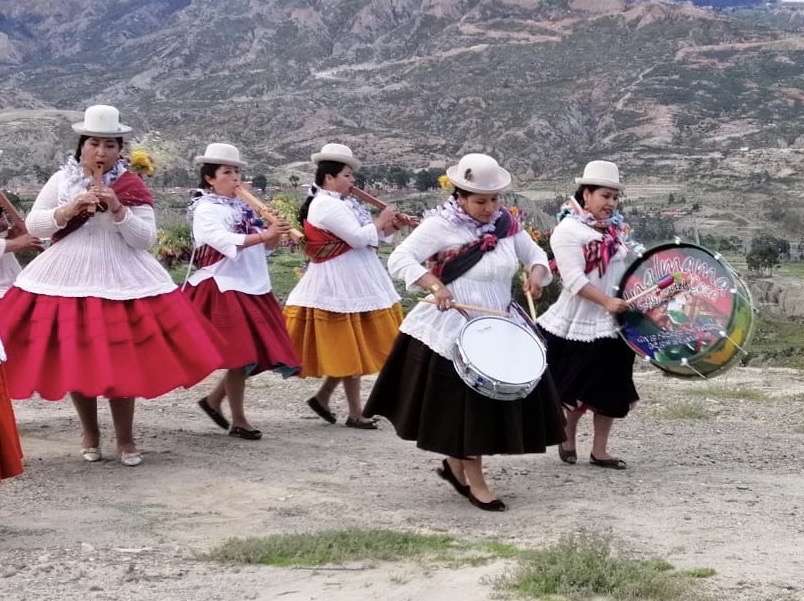
Traditionally, in Aymara-Quechua areas in Eastern Bolivia, women used to play a role in community celebrations by singing, dancing, carrying flags, drumsticks, first aid kits or simply accompanying their husbands. With the arrival of urbanisation and modernity, many women have been forced to abandon any desire to play a wind instrument, even though this social pressure goes against tradition. In response, Phusiris women have been mobilising in indigenous feminist bands, especially in the capital, La Paz. It has not been an easy task, as men have been largely opposed to these changes.
The Phusiris bands that we know today were created in the 90’s with schools playing an important role. Thanks to music lessons at school, women have been able to acquire a certain freedom in choosing which instrument to play, how to play it and when to perform it without being intimidated or challenged by men. Schools have given them the security and confidence to form their own musical identity, through song, customs and other elements that characterise Bolivian traditional culture.





Having read this I thought it was really enlightening. I appreciate you taking the time and energy to put this information together. Elissa Rhys
Thank you for this lovely article! I am interested to know where the word Phusiri comes from. What does it mean?
I looked up the etymology of Phusiri in an Aymara-Quechua dictionary and basically it means “the person who blows”. “Phusaña” is the instrument they use to blow on the kitchen stove (“qiri”).
I am an anthropology professor. I would like to talk to you about a skeletal case excavated from an archaeological site on the Taraco peninsula of southern Lake Titicaca, that dates to the Tiwanaku time period. Can you please email me (July 27, 2025)